

Semaglutide and the Biology of Desire: How GLP-1 Therapy Rewrote the Story of Obesity, Diabetes, and Craving
By Almaz Sharman, Professor of Medicine
The End of “Eat Less, Move More
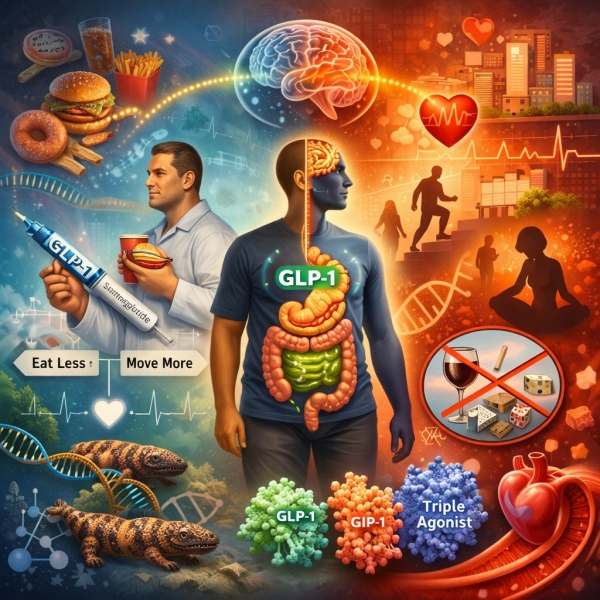
If you look at the history of medicine, it is easy to notice: humanity has sought a “simple answer” to obesity more than once. And almost every time, this answer sounded the same — “eat less and move more.” In practice, this formula worked as a universal slogan, but rarely became a sustainable solution.
For decades, obesity was framed as a matter of behavior, discipline, motivation, and “willpower.” Patients were given logical recommendations and sometimes ideal meal plans. Yet the central biological mechanism — hunger and satiety — remained largely outside the scope of treatment.
The arrival of GLP-1 receptor agonists changed that paradigm. For the first time, medicine began treating not the patient’s “discipline,” but the biological regulation of appetite itself.
When the Noise Finally Stops
Many patients lived for years in a reality where hunger returned too quickly, satiety was brief, cravings persisted, and stopping after a sufficient portion felt nearly impossible.
Then something unexpected happened.
With semaglutide therapy, patients began describing a striking experience: “It became quiet in my head.” A background noise — once mistaken for personality or weakness — seemed to switch off.
Medicine received a powerful confirmation: what had long been interpreted as lack of willpower was often physiology.
GLP-1: The Hormone That Was There All Along
GLP-1 (glucagon-like peptide-1) is an incretin hormone released after eating. Its message is clear: “We have eaten — it is enough.”
Its physiological roles are extensive:
- Glucose-dependent stimulation of insulin secretion
- Suppression of glucagon
- Slowing of gastric emptying
- Promotion of satiety
- Modulation of appetite through the gut-brain axis
For years, metabolism was presented simplistically: the pancreas regulates glucose, insulin is the protagonist, and the gut digests food. Incretin research overturned this view. The gut is not passive — it is an endocrine organ integrated with neural energy-control systems.
Obesity emerged not as a “nutritional mistake,” but as a disorder of a complex satiety network linking gut, brain, and metabolism.
From Diabetes Drug to Obesity Breakthrough
Semaglutide did not begin as a weight-loss solution. GLP-1 agonists were developed to improve type 2 diabetes outcomes — lowering HbA1c, stabilizing glucose, and reducing vascular risk.
The first drug in the class, exenatide, was approved in 2005. Development progressed toward longer-acting, more convenient formulations.
A fascinating chapter accelerated progress: the discovery of a GLP-1–like peptide in the saliva of the Gila monster. It lasted longer than native human GLP-1, proving that satiety signals could be stabilized and prolonged.
For nearly two decades, weight loss was seen as a “secondary bonus.” Only later, when semaglutide 2.4 mg was tested in patients with obesity without diabetes — producing average weight reductions around 15% — did the shift occur.
The same molecule took on two identities:
- Ozempic — for type 2 diabetes
- Wegovy — for obesity
One biology. Two clinical contexts. Overlapping regulatory systems.
How Semaglutide Works: Rewriting the Signal System
Semaglutide does not “force” patients to eat less. It changes the signaling environment.
Patients report:
- Earlier satiety
- Quieter hunger
- Reduced food obsessiveness
- Smaller portions without struggle
It does not break a person. It modifies the neuroendocrine context in which eating decisions occur.
Pre-Ingestive Satiety
Remarkably, fullness may begin before eating, via hypothalamic circuits. This “pre-ingestive satiety” reduces the impulsive state where stopping feels impossible. Eating becomes calmer — not because of effort, but because the impulse itself is weaker.
Slowing Gastric Emptying
Semaglutide slows gastric emptying. Food remains in the stomach longer, mechanical satiety signals intensify, and portions that once felt normal may now feel excessive.
For many, the body finally says “enough” in time.
The Gut-Brain Axis and Reward
GLP-1 agonists influence reward systems. Cravings for sweets, fats, emotional snacking, and automatic eating often decline. Some patients shift toward simpler foods.
For clinicians, this changes everything. Adherence becomes biologically easier.
Obesity as a Chronic Condition
Obesity rarely behaves like a one-time project. After weight loss, the body activates protective mechanisms: hunger rises, energy expenditure drops, and cravings intensify. Like a thermostat, physiology seeks its former set point.
This explains weight regain.
Semaglutide is therefore increasingly viewed as long-term therapy — comparable to treatment for hypertension or dyslipidemia. Stopping treatment often stops the effect because pharmacological satiety support is withdrawn.
The Incretin Race: A New Pharmacological Era
Semaglutide opened the door, but it is not the endpoint.
A new generation is emerging:
- Semaglutide — GLP-1 agonist
- Tirzepatide — GLP-1 + GIP agonist
- Survodutide — GLP-1 + glucagon agonist
- Retatrutide — triple agonist (GLP-1 + GIP + glucagon)
Some trials demonstrate weight reductions approaching bariatric surgery.
Obesity pharmacotherapy is no longer a “weak adjunct.” It is becoming a serious risk-reduction strategy.
Side Effects and Clinical Nuance
Common side effects include:
- Nausea
- Heaviness
- Constipation
- Dizziness
- Mild heart rate increase
They are typically strongest during titration and often decrease over time — even as weight loss continues. This separation between efficacy and tolerability suggests partially independent biological pathways.
Beyond Weight: Metabolic and Anti-Inflammatory Effects
GLP-1 drugs often improve components of metabolic syndrome:
- Glucose dysregulation
- Hypertension
- Dyslipidemia
- Visceral adiposity
They shift from aesthetic tools to long-term risk-management agents.
Potential systemic anti-inflammatory effects are also under investigation.
Clinical Risk Zones
Rare but Serious Signals
- Pancreatitis
- Gastroparesis
- Thyroid safety discussions
Safety signals do not equal proven causality — but vigilance is required.
Muscle Mass and Nutritional Deficits
Weight loss may include lean mass. Without protein support and resistance training, sarcopenia and weakness can occur.
Eating Disorders
In patients with restrictive tendencies, appetite suppression may amplify pathology. Screening is essential.
A Social and Ethical Event
Few drugs reshape not only clinics but markets. Reduced appetite across millions affects demand for snacks, alcohol, and processed foods.
An ethical dilemma emerges: Are we medicalizing a societal food problem?
Yet medicine cannot wait for food systems to reform. Patients need help now.
Semaglutide as a Drug for Desire
Initially framed as a weight-loss injection, semaglutide now appears to act on something deeper — the architecture of desire.
Patients describe reduced craving not only for food but sometimes for alcohol, nicotine, and other compulsive behaviors.
GLP-1 participates in neural reward circuits. Where there was once an impulse — “I want more” — there is now a pause.
Alcohol, Addiction, and Early Signals
National data show reduced alcohol-related hospitalizations among GLP-1 users. This is observational, not definitive proof — but clinically meaningful.
Evidence for nicotine and drug addiction is earlier-stage but growing.
A new scientific direction is emerging: regulating craving biologically.
Cardiovascular Outcomes: A Turning Point
Large trials demonstrate reduced heart attack, stroke, and cardiovascular death risk in high-risk patients.
This moves semaglutide beyond weight control into prognosis modification.
Oncology: Caution and Data
Current large datasets do not confirm a convincing increase in overall cancer risk. However, most evidence is observational. Ongoing vigilance is necessary.
What Ultimately Changes?
Semaglutide demonstrated something profound: overeating is not always a character flaw. Often, it is dysregulated biology.
Now a larger possibility appears — perhaps this class of drugs reduces not just hunger, but the intensity of compulsive impulses themselves.
It is not a beauty pill.
It is evidence that desire can be biologically regulated.
And that realization changes not only obesity treatment — it reshapes how we understand human behavior itself.