

OBESITY IS PHYSIOLOGY: THE MOMENT MEDICINE CEASED BLAMING THE PATIENT
Almaz Sharman, Professor of Medicne
Why the talk about semaglutide is no longer just a talk about weight loss
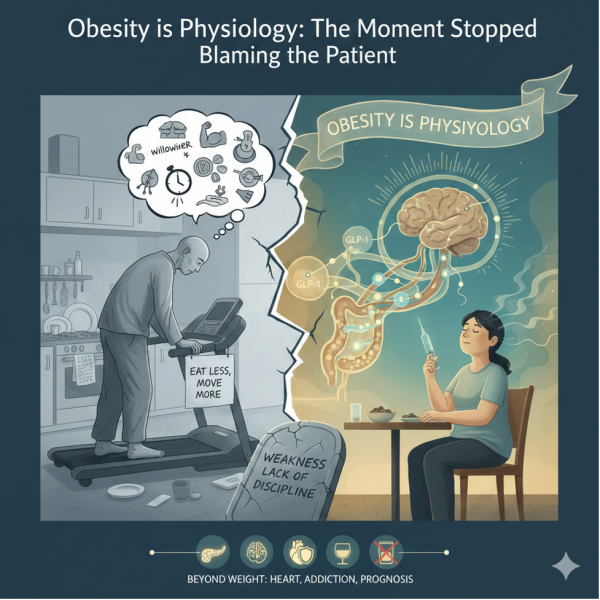
If you look at the history of medicine, it is easy to notice: humanity has more than once sought a "simple answer" to obesity. And almost every time, this answer sounded the same—"eat less and move more." In practice, this formula worked as a universal slogan, but rarely became a sustainable solution. The reason is simple: for decades, people tried to explain obesity through behavior, discipline, motivation, and the "willpower" of the patient. The patient was offered correct advice, logical recommendations, and sometimes even ideal meal plans—but the mechanism of hunger and satiety itself remained outside the field of treatment, as if it did not matter.
With the appearance of GLP-1 receptor agonists, the situation has radically changed for the first time. Preparations of this group—and primarily semaglutide (known as Ozempic, Wegovy, Mounjaro, etc.)—have become a rare example of pharmacotherapy that acts not on the "correctness" of the patient, but on the biological system of appetite and metabolism regulation. And it is precisely this that has overturned the very logic of discussing obesity.
Many patients lived for years in a reality where: hunger returned too quickly, the feeling of satiety was short, food cravings did not turn off, and it was difficult to "stop" even after a sufficient portion. And when, against the background of semaglutide therapy, this internal pressure suddenly disappeared, people described it as if it finally became quiet in their head: as if a constant background noise, which was previously perceived as part of one's character or personality, was switched off. Thus, medicine received a rare confirmation: what we called "weakness" was often physiology.
GLP-1: The hormone that was literally "under our nose" for a long time
Glucagon-like peptide-1 (GLP-1) is a gut hormone (incretin) that is released after a meal and transmits an extremely clear signal to the body and brain: "we have eaten—that is enough."
GLP-1 has several key roles:
- Regulation of insulin secretion (glucose-dependent).
- Reduction of glucagon secretion.
- Influence on the rate of gastric emptying.
- Participation in the formation of satiety and appetite control.
- Influence on eating behavior through the gut-brain axis.
For a long time, metabolic regulation was presented simplistically: the pancreas manages glucose, insulin is the main hero, and the intestine simply "digests food." But studies of incretins have shown that the intestine is an endocrine organ built into the neural system of energy control. And this became one of the main scientific pivots: obesity turned out to be not only a "nutritional error," but the result of a complex architecture of satiety signals, where the intestine, brain, and metabolism work as a single network.
How semaglutide appeared: a story involving both science and chance
In popular culture, a feeling arose as if semaglutide appeared suddenly—"like a fashionable injection for weight loss." But the real story is much deeper and slower. The development of GLP-1 agonists began not as an anti-obesity strategy, but as an attempt to improve the treatment of type 2 diabetes: to lower HbA1c, reduce glucose variability, decrease the risk of vascular complications, and improve prognosis.
The first drug in the class was exenatide, approved in 2005. Then pharmacology moved towards longer action and convenience of use—and gradually, weekly administration forms appeared. But there is a detail in this story that is almost "cinematic": development was accelerated by the discovery of a GLP-1-like peptide in the saliva/venom of the Arizona Gila monster. This molecule acted longer than human GLP-1 and became natural proof that "if you make the satiety signal more stable, the effect will be long-lasting." This is exactly how a scientific idea received biological reinforcement: satiety can not just be stimulated; it can be prolonged.
From diabetes to obesity: the moment it became clear we missed decades
One of the ironies of medicine lies in the fact that humanity actually lost about 20 years by perceiving GLP-1 drugs as exclusively diabetological agents. Yes, patients lost weight—but at first, it was considered a secondary bonus. Early large studies with drugs of this group showed not only improvement in glycemia but also a reduction in cardiovascular risks. However, the weight reduction was moderate, and focus remained on diabetes.
The real change of era occurred later, when semaglutide was tested in patients with obesity without diabetes at a dosage of 2.4 mg and yielded an average body weight loss of about 15%. Thus, the same molecule became established in two clinical roles: Ozempic—therapy for type 2 diabetes; Wegovy—therapy for obesity (the same molecule, but a different goal and dosage). This is important not only legally and for marketing—it shows how one biology can be applied in two pathological contexts: in one case—glucose, in the other—body weight and appetite, yet the regulatory systems overlap.
How it works: semaglutide doesn't "force you to eat less"—it changes the signaling system
One of the key tasks of a doctor is to explain the mechanism to the patient correctly. Because semaglutide is not a story about punishment and not a story about willpower. It is a story about what a person begins to feel for the first time: satiety comes earlier, hunger is quieter, "food obsession" is weaker, and portions become smaller without a constant struggle. It does not "break" the person. It changes the neuroendocrine environment in which the person exists.
Pre-ingestive satiety: fullness even before the meal begins
One of the most interesting observations of recent years is that the feeling of fullness can arise before eating, through central mechanisms (hypothalamic circuits). This is called pre-ingestive satiety. From a practical point of view, this means: the patient less frequently enters a state of food "impulse" when it is almost impossible to stop. They eat more calmly, more slowly, and not because they "pulled themselves together," but because the very strength of the impulse is lower.
Slowing of gastric emptying
The second part of the effect is more "mechanical": slowing of gastric emptying. What this provides: food stays in the stomach longer, the stretching of the walls and mechanical signals of satiety are intensified, and the volume of a previous portion begins to be accompanied by heaviness or nausea. Important: for the patient, it looks as if the body is finally telling them the truth on time: "enough," and not 40 minutes after overeating.
The gut-brain axis: influence on cravings and food reward
GLP-1 agonists act not only on the stomach. They affect the gut-brain axis and reward systems. Therefore, in some patients, cravings for sweets, fats, "emotional snacking," and the habit of finishing food automatically are reduced. Some describe even a shift in preferences: from snacks and desserts to simpler food (fish, vegetables, neutral dishes). For a dietician and nutritionist, this is fundamental: it becomes realistically easier for the patient to follow recommendations not because "they are good," but because the internal pressure of appetite decreases.
Obesity as a chronic condition
In real practice, obesity almost never behaves like a one-time task of "drop it and forget it." Even after a successful diet, the body switches on mechanisms to protect body weight: hunger intensifies, energy expenditure falls, and the craving for high-calorie food increases. This is like a "thermostat" that seeks to return the body to its former range. That is why the phenomenon of weight loss appearing, then returning, sometimes with an increase, occurs.
Thus, the model of therapy is also gradually changing: semaglutide is increasingly considered not as a short course, but as long-term treatment, comparable in logic to therapy for hypertension or dyslipidemia-atherosclerosis. And there is honesty in this: stopping therapy often means stopping the effect—because we stop the pharmacological support of satiety.
Effectiveness: semaglutide, tirzepatide, and the incretin race
Semaglutide became the door to a new era, but not the finale. A pharmacological race of "gut hormones" has begun:
- Semaglutide (Ozempic, Wegovy) — GLP-1 receptor agonist.
- Tirzepatide (Mounjaro) — dual GLP-1 + GIP agonist.
- Survodutide — dual GLP-1 + glucagon agonist.
- Retatrutide — triple agonist (GLP-1 + GIP + glucagon).
In a number of trials, new molecules demonstrate body weight reduction at a level approaching the effects of bariatric surgery—and sometimes comparable to it. For a doctor, this means a fundamentally new position for obesity pharmacotherapy: it becomes not a "weak addition," but a serious tool for risk reduction—comparable in scale to statins and antihypertensive therapy.
Side effects: why they exist—and why they are not always equal to effectiveness
The most frequent side effects of GLP-1 agonists are of the GI spectrum: nausea, heaviness, constipation, belching, weakness, dizziness (often due to a sharp reduction in calories), and sometimes an increase in resting heart rate.
A key clinical nuance: side effects are more pronounced at the beginning and during titration, but then often diminish, while weight loss persists. This looks untypical for pharmacology, where "strength of effect = strength of side effects." Here, the possibility of partial independence of pathways is discussed: the circuits associated with nausea/vomiting may be separable from the circuits responsible for sustained appetite reduction.
Metabolic syndrome, inflammation, and effects "wider than weight"
Obesity patients are characterized by metabolic syndrome: glucose disturbance, elevated pressure, dyslipidemia (TG↑, HDL↓), and visceral obesity/waistline. This is not just a "background diagnosis." It is a risk structure that determines: the probability of diabetes, cardiovascular events, inflammatory background, and prognosis for decades.
GLP-1 drugs often improve these components. Therefore, they become a tool not of aesthetics, but of managing long-term risks. Separately, a possible systemic anti-inflammatory effect is discussed in scientific literature: GLP-1 receptors are widely represented in the brain, and a reduction of inflammation in the body as a whole may be mediated through central mechanisms.
Risk points in real practice: what must be spoken about honestly
Possible rare complications
There are risks and signals requiring clinical vigilance and monitoring: pancreatitis (rare, but a severe complication), gastroparesis and the risk of bowel obstruction in some patients, potential thyroid risks (and regulatory discussions). It is important to remember: a safety signal ≠ proven causality. But this is a zone where the doctor is obliged to be attentive and correctly select patients.
Loss of muscle mass and nutritional deficits
Weight loss is not always just fat. Without the accompaniment of nutrition and exercise, a patient can also lose lean mass, increasing the risk of: weakness, sarcopenia, and worsening of functional status, especially in older age. Also possible is a scenario of "too much appetite reduction": the patient eats little and stops getting enough protein, microelements, and normal diet structure. This is a key area of work for the dietician/nutritionist: not just "fewer calories," but maintaining protein, fiber, micronutrients, and muscle tissue.
Risks for patients with eating disorders (ED)
A separate red zone is patients with a tendency toward ED, especially of the restrictive type. For them, the drug can become an "amplifier" of pathology: if hunger is switched off too effectively, it can facilitate dangerous starvation and consolidate destructive food control. Therefore, screening of eating behavior and psychological risks before starting therapy is not a formality, but part of modern safe medicine.
Semaglutide as a social event: economics, culture, and ethics
Rarely does a drug so noticeably affect not only the clinic but also society. When the appetite of millions of people decreases, the demand for snacks, fast food, sweets, and alcohol changes. This goes far beyond the doctor's office: industries, habits, and food culture are changing.
But an ethical dilemma arises: are we not turning a societal food problem into an individual medical story, where the environment remains the same and responsibility is transferred to an injection? On the other hand, medicine cannot wait for an ideal change in the food industry. The patient needs help today—in an environment where overeating has become the norm and high-calorie food is constantly available.
Practical conclusion for specialists: what semaglutide actually is
If we gather everything into one clinical definition, it might sound like this:
Semaglutide is not a "medicine that makes you thin." It is a drug that intervenes in the physiology of satiety, reduces the pathological craving for overeating, and helps maintain metabolic control in a modern food environment.
But the effectiveness of the drug is maximally revealed not "alone," but in a system:
- Competent dose titration.
- Diet correction (especially protein and fiber).
- Monitoring of nutritional deficits.
- Prevention of muscle mass loss (strength training).
- Management of side effects.
- Assessment of psychological risks and ED.
- Long-term accompaniment (obesity is more often a chronic condition).
Conversation about the future: Semaglutide as a "medicine for craving"
When semaglutide first became a global sensation, it was discussed almost exclusively in one plane: weight loss. An injection that "turns off the appetite." A drug that makes you eat less. A new symbol of an era of quick solutions. But the longer doctors and researchers observed patients on GLP-1 therapy, the clearer it became: we are not talking just about kilograms. Semaglutide, it seems, touches a much deeper mechanism—the system of desire.
Not only "minus weight," but also minus craving
Patients describe the effect of semaglutide in surprisingly similar words: "it became quieter in my head." The constant background "call of food" disappears, the feeling of endless internal tension that previously did not let go vanishes. And almost in parallel, new reports appear: some people begin to notice that they want to drink less alcohol, feel calmer about "emotional" snacks, find it easier to quit smoking, or lose interest in habitual "dopamine" rituals.
The science is already getting closer to an explanation. The fact is that GLP-1 is not only a hormone of "satiety" but also part of a complex neural network connected to the reward system. Where an impulse "I want more" previously acted, a pause suddenly appears. And for the first time, a person gets the opportunity to choose—not out of struggle, but out of calmness.
Alcohol: the first serious signals
The most convincing signal among all "addiction" effects is alcohol. A large study on national data showed that in people taking GLP-1 drugs, the risk of alcohol-associated hospitalizations decreased. That is, we are no longer talking only about a subjective "less craving," but about statistically noticeable consequences in a real clinic. But an important caveat sounds like this: this does not yet mean that semaglutide can be officially considered a medicine for alcohol addiction. Right now, this is rather a territory of a transition period—between observation and proof.
Smoking and drugs: a hypothesis that is becoming a direction
With nicotine and drug addictions, the situation is more complex: there are currently more preclinical data and early studies than large clinical evidence. But the interest of the medical community is growing rapidly. The logic here is clear: if a drug reduces appetite not through willpower, but through the neurobiology of desire—why can it not act on other forms of craving? This is no longer science fiction—it is a cautious scientific bet on the future.
Heart: an effect that can no longer be ignored
But if in addictions semaglutide is only beginning to reveal its "supporting roles," in cardiology it has already become a serious event. A large study showed: in people with obesity or overweight and pre-existing cardiovascular diseases, semaglutide reduces the risk of major events—heart attack, stroke, and death from cardiovascular causes. And this is a turning point: the drug stops being just a means "for weight control." It enters the category of medicines that actually affect prognosis.
And cancer? Here medicine says "carefully" for now
The most sensitive topic is oncological risks. There was much and loud debate about this: fears were voiced that intervention in the hormonal system could carry distant threats. But new large data look encouraging for now: a convincing increase in overall cancer risk on GLP-1 therapy is not confirmed, and for some types of tumors associated with obesity, associations with risk reduction are even observed. However, it is important to emphasize: this is mainly observational science. It can show trends, but it cannot always prove causality.
What changes in the end?
Semaglutide became the first drug that vividly showed: human overeating is not always a "weakness of character." Often, it is a failure of the biological management of desire. And now an even more unexpected perspective appears: perhaps we have approached a class of drugs that can reduce not only hunger, but the very strength of obsessive impulses—those that stand behind addictions, compulsive habits, and chronic "I want more."
While the world discusses semaglutide as a means for excess weight, medicine is beginning to see in it something more. Not a beauty pill. But a tool that shows: desire can be regulated biologically. And this changes not only the therapy of obesity—it changes the view of the human being themselves
REFERENCES
- Australian Prescriber. (2025). Semaglutide for cardiovascular risk reduction in people who are overweight or have obesity without diabetes (new indication). Australian Prescriber, 48, 107-108. doi:10.18773/austprescr.2025.024.
- Bracchiglione, J., et al. (2025). Semaglutide for adults living with obesity: A systematic review and meta-analysis. Cochrane Database of Systematic Reviews. doi:10.1002/14651858.CD015092.pub2.
- Deanfield, J., Verma, S., Scirica, B. M., et al. (2024). Semaglutide and cardiovascular outcomes in patients with obesity and prevalent heart failure: a prespecified analysis of the SELECT trial. The Lancet, 404(10454), 773–786. doi:10.1016/S0140-6736(24)01498-3.
- Drucker, D. J. (2025). Antiinflammatory actions of glucagon-like peptide-1–based therapies beyond metabolic benefits. Journal of Clinical Investigation. doi:10.1172/JCI194751.
- Goodwin Cartwright, B. M. (2025). Monitoring Report: GLP-1 RA Prescribing Trends – September 2025 Data. medRxiv. doi:10.1101/2025.03.06.25323524v4.
- Ismaiel, A., et al. (2025). Gastrointestinal adverse events associated with GLP-1 RA in non-diabetic patients with overweight or obesity: a systematic review and network meta-analysis. International Journal of Obesity, 49(1), 1946–1957. doi:10.1038/s41366-025-01859-6.
- Kosiborod, M. N., Petrie, M. C., Borlaug, B. A., et al. (2024). Semaglutide in patients with obesity-related heart failure and type 2 diabetes. New England Journal of Medicine, 390(15), 1394–1407. doi:10.1056/NEJMoa2313917.
- Krajnc, M., Kuhar, N., & Koceva, A. (2025). Oral semaglutide for the treatment of obesity: a retrospective real-world study. Frontiers in Endocrinology, 16, 1593334. doi:10.3389/fendo.2025.1593334.
- Lincoff, A. M., Brown-Frandsen, K., Colhoun, H. M., et al. (2023). Semaglutide and Cardiovascular Outcomes in Obesity without Diabetes (SELECT Trial). New England Journal of Medicine, 389(24), 2221–2232. doi:10.1056/NEJMoa2307567.
- Linge, J., Birkenfeld, A. L., & Neeland, I. J. (2024). Muscle mass and glucagon-like peptide-1 receptor agonists: adaptive or maladaptive response to weight loss? Circulation, 150(16), 1288–1298. doi:10.1161/CIRCULATIONAHA.124.067676.
- Min, J. S., et al. (2025). A comprehensive review on the pharmacokinetics and drug-drug interactions of approved GLP-1 receptor agonists and a dual GLP-1/GIP receptor agonist. Drug Design, Development and Therapy, 19, 3509–3537. doi:10.2147/DDDT.S506957.
- O’Dowd, A. (2025). GLP-1 receptor agonists: MHRA to study possible side effects after acute pancreatitis cases. BMJ, 389, r1344. doi:10.1136/bmj.r1344.
- Ryan, D. H., et al. (2025). Semaglutide and cardiovascular outcomes by baseline and changes in adiposity measurements: a prespecified analysis of the SELECT trial. The Lancet Diabetes & Endocrinology. doi:10.1016/S2213-8587(25)00112-X.
- Sharman, A., Shaw, J. E., Shayanrad, A., et al. (2024). Semaglutide 2.4 mg versus placebo in people with obesity and prediabetes (STEP 10): a randomised clinical trial. Nature Medicine (as cited in clinical summaries).
- Taylor & Francis. (2025). Semaglutide: a key medication for managing cardiovascular-kidney-metabolic syndrome. Current Medical Research and Opinion. doi:10.1080/14796678.2025.2511412.
- Westermeier, F., & Fisman, E. Z. (2025). Glucagon-like peptide-1 receptor agonists (GLP-1RAs) and cardiometabolic protection: Historical development and future challenges. Biomedicines, 13, 135. doi:10.3390/biomedicines13020135.
- Xie, Y., Choi, T., & Al-Aly, Z. (2025). GLP-1 medications tied to decreased risk of dementia and addiction: A large-scale longitudinal study. Washington University School of Medicine Research Center.
- The BMJ. (2026). Weight regain after cessation of medication for weight management: systematic review and meta-analysis. BMJ, 392, bmj-2025-085304. doi:10.1136/bmj-2025-085304.